
Siberian Tiger vs African Lion: Who Would Win?
This is the ultimate clash of big cat royalty: the undisputed heavyweight king of the frozen Russian taiga versus the proud savanna monarch of the African plains. Here is how biomechanics, veterinary data, and combat physics separate the two legends.
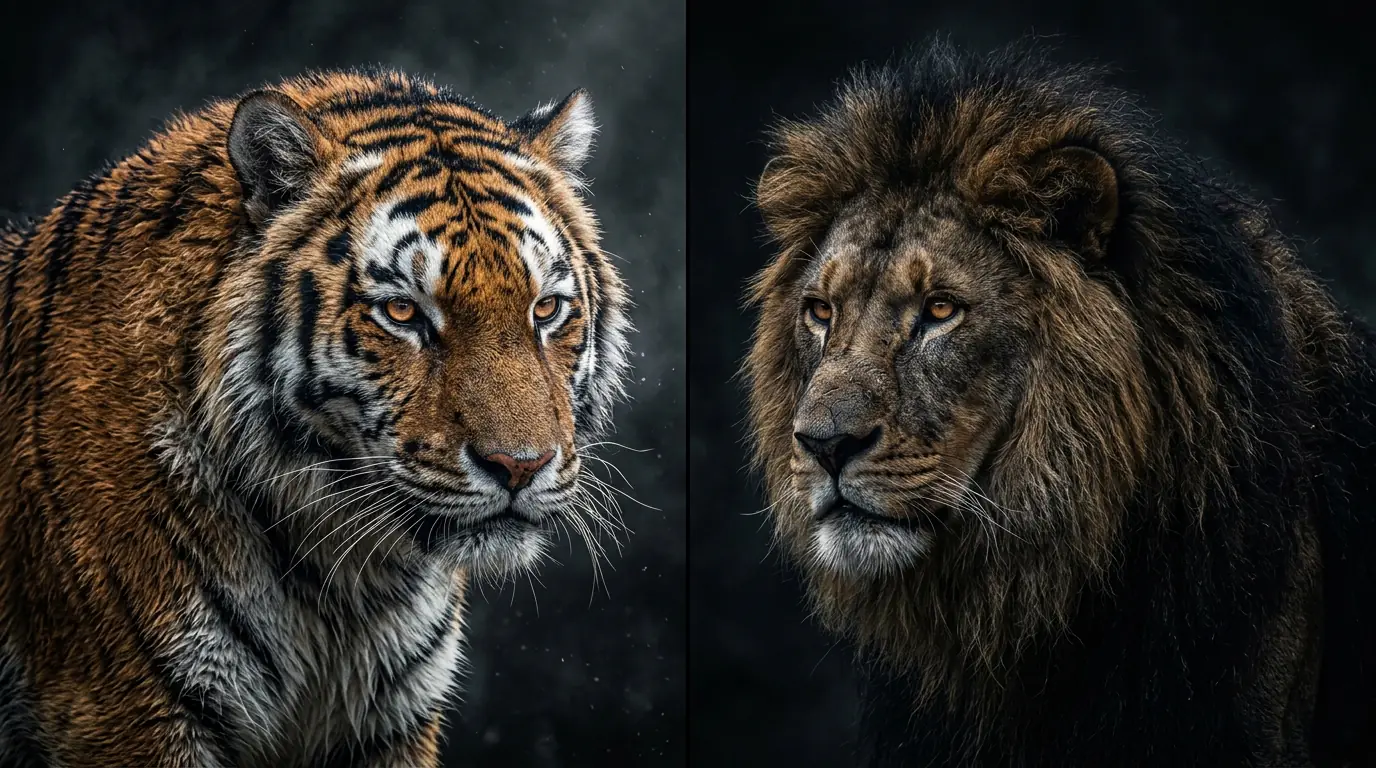
Tale of Two Kings: The Siberian tiger (Panthera tigris altaica) balances unmatched muscle mass and skull density against the African lion's (Panthera leo) defensive mane and pride-tested grit.
Tale of the Tape: Biometric Comparison
| Attribute | 🐅 Siberian Tiger | 🦁 African Lion | Advantage |
|---|---|---|---|
| Male Weight Range | 190–318 kg (419–700 lbs) | 160–225 kg (350–500 lbs) | Tiger (+20% to +40%) |
| Total Body Length | 2.7–3.3 m (8.9–10.8 ft) | 2.6–2.9 m (8.5–9.5 ft) | Tiger (+30–40 cm) |
| Shoulder Height | 105–115 cm | 110–120 cm | Lion (+5 cm upright) |
| Bite Force | ~1,050 PSI (BFQ ~127) | ~650–700 PSI (BFQ ~112) | Tiger (+55%) |
| Canine Tooth Length | 7.5–9.0 cm (3.0–3.5 in) | 6.5–7.6 cm (2.5–3.0 in) | Tiger (+1.5 cm) |
| Top Sprint Speed | ~60 km/h (short burst) | ~80 km/h (savanna sprint) | Lion (+20 km/h) |
| Combat Strategy | Bipedal wrestling & spine lock | Shoulder clash & throat clamp | Tiger (Wrestling) |
| Defensive Armor | Dense subcutaneous fat layer | Full keratin throat mane | Lion (Mane shield) |
1. The Weight & Bone Density Equation
In predatory animal fights, body mass is the single most decisive variable. At equal maturity, a prime male Siberian tiger outweighs an adult male African lion by 30 to 70 kilograms. Furthermore, veterinary studies on felid bone geometry reveal that Siberian tigers carry thicker, denser humerus and femur bones, built to drag 500+ kg elk and wild boar through deep snow without assistance.
This heavier bone density produces superior kinetic force during paw swipes—estimated by wildlife biomechanics models at upwards of 4,500 kg-m/s², capable of dislocating prey joints in a single strike.
2. Skull Biomechanics & Bite Force
The Siberian tiger possesses a broader zygomatic arch and a taller sagittal crest than the African lion. These skull adaptations provide wider anchor points for the temporalis and masseter muscles, enabling a measured bite force of approximately 1,050 PSI.
While the African lion's 650–700 PSI bite is formidable and ideal for suffocating zebra and wildebeest windpipes, the tiger's bite delivers bone-crushing canine penetration capable of penetrating dense neck vertebrae directly.
3. Combat Tactics: Mane Defense vs. Bipedal Balance
The lion's primary combat advantage is its glorious dark mane. Developed through thousands of generations of bloody pride defense battles against rival male coalitions, the mane acts as natural chainmail, making it extraordinarily difficult for an opponent to secure a lethal throat or neck bite.
However, the Siberian tiger counters with supreme rear-leg balance. Solitary tigers regularly stand bipedally during fights, slashing simultaneously with both heavily clawed front paws. Male lions, by contrast, typically maintain three legs on the ground for stability and strike with a single paw, putting them at a severe disadvantage in close-quarters wrestling exchanges.
The Scientific Verdict: 75% Tiger Victory
While the African lion's pride-tested combat endurance and defensive mane guarantee an intense battle, the Siberian tiger's overwhelming advantages in mass, skeletal strength, bite force, and two-paw wrestling leverage make it the decisive statistical favorite.
Frequently Asked Questions
Who would win: Siberian tiger or African lion?
In a physical one-on-one duel, the Siberian tiger holds substantial biometric advantages: a massive weight disparity (+30 to 70 kg in historical peak specimens), thicker forelimb bones, and a bite force over 1,000 PSI compared to ~650 PSI for an African lion. While a male lion's mane offers defensive neck protection, the Siberian tiger's raw grappling power and agility give it a 70–75% statistical likelihood of victory.
Is a Siberian tiger bigger than an African lion?
Yes, significantly bigger. Adult male Siberian tigers historically reached 190–318 kg (419–700 lbs) with total body lengths up to 3.3 meters (11 feet). Male African lions average 160–225 kg (350–500 lbs) and 2.6–2.9 meters in length. The Siberian tiger is the largest living felid in the world.
Can an African lion kill a Siberian tiger?
While improbable under equal adult male conditions, an African lion can be lethal if it sustains combat long enough to fatigue the heavier tiger, or if its thick mane successfully deflects killing bites to the jugular. However, in verified single combat, the tiger's bone density and weight advantage make a lion victory rare.
Do Siberian tigers and African lions ever meet in the wild?
No. Siberian tigers inhabit the birch and coniferous taiga forests of the Russian Far East and Northeast China, while African lions live thousands of miles away across sub-Saharan African savannas and grasslands. Their paths never cross in nature.